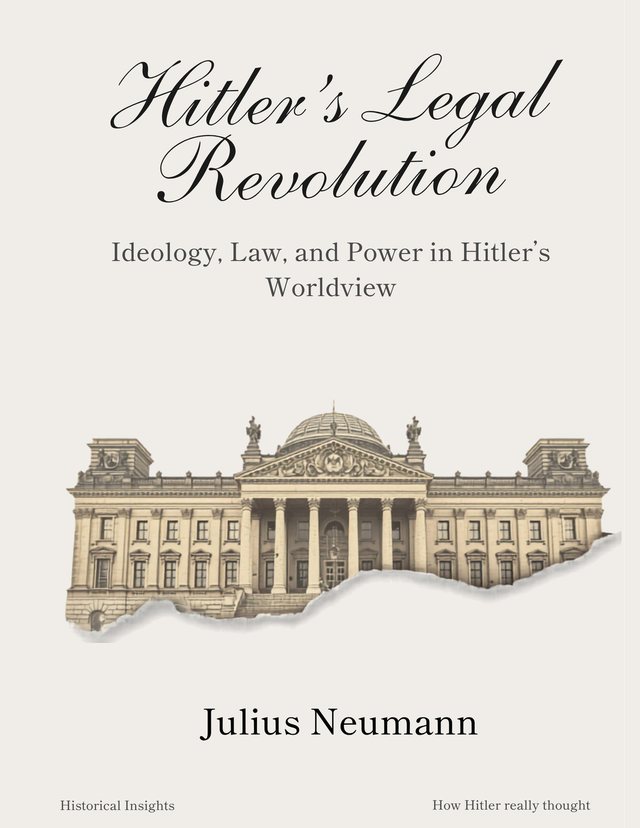
History · Nonfiction
Hitler’s Legal Revolution
Ideology, Law, and Power in Hitler’s Worldview
How does a worldview become a state? Most books explain what the Third Reich did. This one asks how Hitler’s own beliefs about race, revolution and the nation were translated, article by article, into the laws that governed a country.
Price in US dollars; you can pay in your local currency at checkout. Tax included. Sold by Paddle.com as Merchant of Record. By buying you agree to the Terms and Refund policy.
About the book
Drawing on nearly 600 pages of primary sources, speeches, memoranda, decrees and the administrative machinery of Nazi rule, Hitler’s Legal Revolution reconstructs Hitler’s ideology on its own terms: not as a fixed blueprint and not as opportunistic chaos, but as a framework flexible enough to justify contradictory tactics while never abandoning its racial core.
This is not a biography, and it takes no side in the historians’ long argument over whether ideas or institutions drove the regime. It takes a clear position instead: that Hitler’s worldview gave the machinery of the Third Reich its direction, and that understanding how is the only real defence against it happening again.
Across seven parts the book covers the foundations of Hitler’s ideology, his view of the classes of German society, the Führerstaat and the questions of succession and monarchy, race and historicism, foreign policy and Lebensraum, and his idea of revolution, from 1789 to the Röhm crisis of 1934. Rigorously sourced. Unflinching in its moral judgement. Written to explain, not to excuse.
From the introduction
I wrote this book to replace cliché with clarity.
Contents
- Introduction
- Adolf Hitler: Life, Ideology, and Historical Contradictions
- Part I: Foundations of Hitler’s Worldview
- Part II: Society and Social Classes
- Part III: State, Authority, and Leadership
- Part IV: Race, History, and Ideology
- Part V: Foreign Policy and Expansion
- Part VI: Revolution and Violence
- Part VII: Conclusion
- Sources and Source Criticism